




The traditional method for maintaining an age-synchronized population for multi-day studies without interventions is labor-intensive and low-throughput, hindering research on aging mechanisms and the identification of novel interventions for aging. To address these limitations, a novel, robust method was developed to sustain age-synchronized populations in a 96-well plate liquid culture format for up to 12 days without custom-made apparatuses. The robustness of this method was substantially improved by optimizing the surface composition of the multi-well plate and disposables, refining culture parameters, including life stage, medium composition, and bacterial food concentration. To facilitate unbiased phenotype assessment throughout the lifespan, we used a Wmicrotracker ONE reader to monitor worm movement and viability in a multi-well plate. The overall fitness decline with aging using our method is comparable to that of worms maintained on solid agar.
Methods
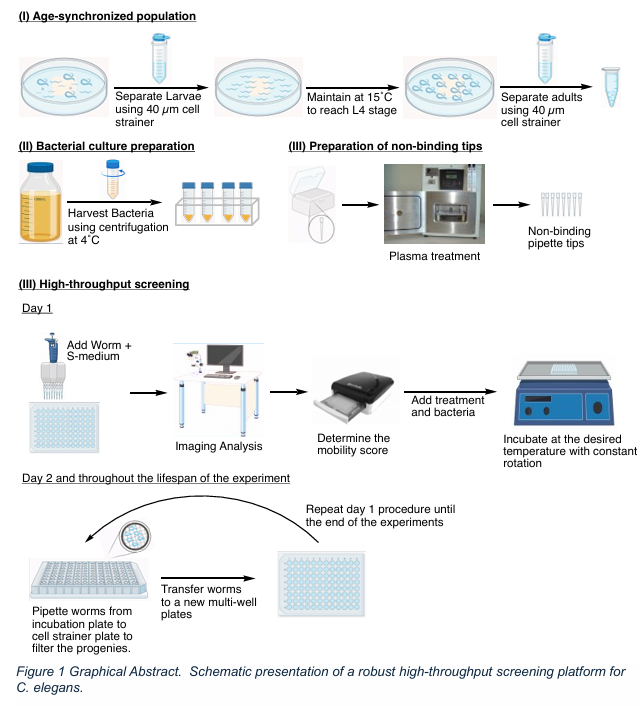
In this study, we developed a novel platform for maintaining age-synchronized populations of C. elegans in liquid culture over an extended period for HT screening, without any chemicals or genetic interventions (Figure 1). This protocol starts with Day 1 adult worms that have been pre-cultured on solid nematode growth medium (NGM). Unlike traditional methods, this approach does not require bleaching, avoiding potential bleaching-induced phenotyping changes, and supports both viable and non-viable food sources for worms, enabling genetic and compound screening within a carefully controlled environment.
Results
Our results demonstrated that our robust platform, with a Z-factor exceeding 0.7, can be used for HT screening of chemical libraries and potentially for genomic studies focusing on adult C. elegans populations. Its scalability and adaptability render it a robust alternative to chemical dependent age-synchronization techniques, with significant implications for research on aging and related disciplines. One of the key challenges in High-Throughput Screening (HTS) is maximizing efficiency while acquiring large datasets for analysis. The method outlined above, when combined with Wmicrotracker ONE technology, undoubtedly accelerates HTS processes.
Fatemeh Yousefsaber, Morteza Sarparast, Brian Johnson, Jamie Alan, Kin Sing Stephen Lee.