




Dithiocarbamate fungicides, including benomyl (methyl-butylcarbamoyl-2-benzimidazolecarbamate), share a common mechanism of toxicity by inhibiting aldehyde dehydrogenases (ALDHs), enzymes essential for detoxifying reactive aldehydes. One such aldehyde, 3,4-dihydroxyphenylacetaldehyde (DOPAL), a dopamine metabolite, is implicated in the catecholaldehyde hypothesis of Parkinson`s disease. This study examines ALDH inhibition as the molecular initiating event (MIE) within an adverse outcome pathway (AOP) leading to neurotoxicity.
Methods
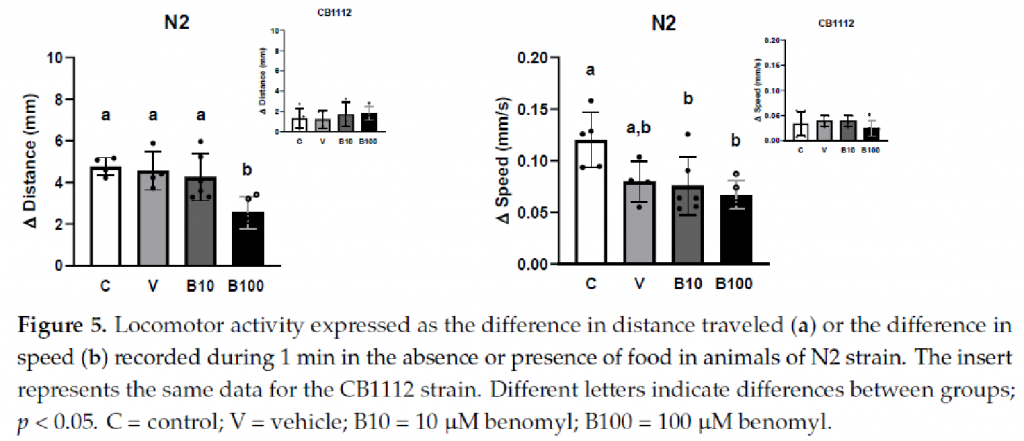
DA Functionality Assessment. Basal Slowing Response: The experimental procedure was set up according to Albrecht et al. (2022), adapted from Chakraborty et al., 2015. At the end of benomyl exposure, 10–15 N2 animals were transferred to plates with NGM medium. After 5 min of habituation, speed and distance traveled for 1 min were measured using WMicrotacker Smart device software (Phylumtech SA, Argentina). The results were expressed as the difference in distance traveled or speed in the absence and presence of food for both the N2 animals and the CB1112 strain, which was considered a positive control for this behavior, provided the low dopamine content resulting from the TH null mutation.
Results
Basal Slowing Response. Figure 5a shows the difference in walking distance between the N2 (a) and CB1112 strains (insert c) between the fed and fed conditions, demonstrating the absence of differences related to the presence of food between the two strains (p = 0.74). A one-way ANOVA revealed significant differences in walking distance at p = 0.01 for each strain. Figure 5b shows the difference in walking speed considering the feed/food absence conditions for N2 (a) and CB1112 strains (insert c). Since the two-way ANOVA failed to establish a significant interaction between strains and experimental groups, the results were compared using one-way ANOVA, analyzing each strain separately. Wild-type animals showed a statistically significant effect: p < 0.05, due to the difference between the benomyl exposed and control groups. As expected, the results demonstrated a difference compared to the control group in both conditions (with and without food) in locomotor activity assessed as distance travelled and speed. Locomotion was greater in the no-food condition, as evidenced by the animals ability to discriminate a surface with food and reduce their locomotion by approximately 60%. Finally, as expected, this difference in locomotion was less evident in the CB1112 strain tested as a control, since it presents a mutation for the TH enzyme with DA levels between 30 and 40% compared to the wild-type strain.
Fernandez-Hubeid LE, Deza-Ponzio R, Albrecht PA, Romero VL, Gonzales-Moreno C, Ferreyra MR, Moran YS, Virgolini MB.