




In this study, we investigate the anti-obesity effects of BRB-F-S (Black rice bran fermented with Shiitake mycelium–derived supernatant) using a high-fat diet-induced Caenorhabditis elegans model. The global rise in obesity has increased interest in natural anti-obesity agents. Black rice bran, a by-product of rice processing, is rich in polysaccharides and polyphenols, whose bioavailability can be enhanced through fermentation. In this study, we investigated the anti-obesity effects of polysaccharide-rich black rice bran fermented with Shiitake mushroom mycelium, using Caenorhabditis elegans as an in vivo model.
Methods
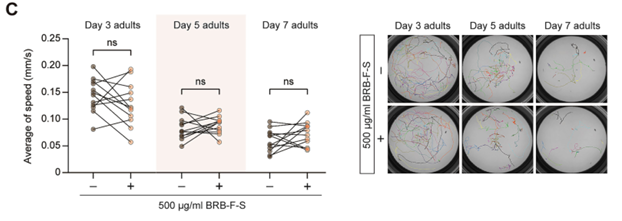
Locomotion speed assay. L4-stage worms were supplemented with 500 μg/mL BRB-F-S for 3, 5, or 7 days to obtain day 3, 5, and 7 adults, respectively, under standard diet conditions. As controls, age-matched worms maintained under identical conditions without BRB-F-S supplementation were used. Worms were washed three times with an M9 buffer and transferred (10–20 worms per plate) onto unseeded 35-mm NGM plates for brief recovery. Locomotion was assessed using the WMicrotracker SMART ×8 system and its associated software (Phylumtech, Argentina). Worms were exposed to blue light stimulation for 10 s, followed by a 5-min video recording.
Results
Motility was assessed using both liquid-based thrashing and solid-based body bending assays at days 3, 5, and 7 of adulthood. In the thrashing assay, BRB-F-S-treated worms maintained significantly higher locomotor activity at days 5 and 7 compared to untreated controls, consistent with a delay in age-associated decline in neuromuscular function. In contrast, body bend speed on solid medium remained unchanged (Figure 2C), suggesting that the beneficial effects of BRB-F-S are more pronounced under conditions requiring continuous dynamic movement.
Front. Sustain. Food Syst., 11 January 2026 Frontiers
Eunyoung Jun , Sangyeong Kim , Seonyu Lim , Chanmi Jang and Kyung Won Kim.