




Caenorhabditis elegans and Heligmosomoides polygyrus are excellent parasitic nematode models for anthelmintic drug discovery and for elucidating the mechanism of action due to their similarity to parasitic species. The rapid cycle and ease of culture make these nematodes an excellent tool for the anthelmintic activity of substances. The present study was undertaken to evaluate the anthelmintic activity of the combination of K. grandifoliola and F. albidastem barks in order to determine potential synergistic or antagonistic effects and to provide scientific justification for their traditional use in combination within the Chadian pharmacopeia for the treatment of helminthiasis.
Methods
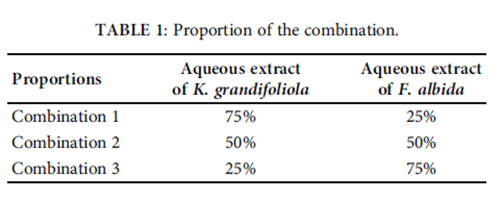
Anthelmintic Activity of Combined Extracts on L3 Larvae of H. polygyrus and L4 C. elegans Larvae. The anthelmintic tests using combinations of K. grandifoliola and F. albida were carried out using the combination protocol described in Table 1. The test on L3 and L4 was carried out as described by Santos et al. with some modifications. The concentrations tested were the same as in the original method: 2.5, 1.25, 0.635, 0.312, 0.151, and 0.078 mg/mL for L3 and 100, 50, 25, 12.5, 6.25, and 3.125 μg/mL for L4. However, in this study, the stock solutions used to prepare these concentrations were obtained by first mixing the extracts indifferent proportions, as shown in Table 1. Combination 1 consisted of 75% K. grandifoliola and 25% F. albida; Combination 2 consisted of 50% K. grandifoliola and 50% F. albida; and Combination 3 consisted of 25% K. grandifoliola and 75% F. albida. Fifty worms were placed in individual wells of a multiwell plate (usually a 96-well plate) containing 200 μL of the testing solution and incubated for 24 h in a Worm MicroTracker system to monitor the movement and behavior of the worms. This system uses advanced imaging and tracking algorithms to measure parameters like motility, frequency of movement, and other locomotor activities. The percentage inhibition (PI) of larval motility was determined.
Results
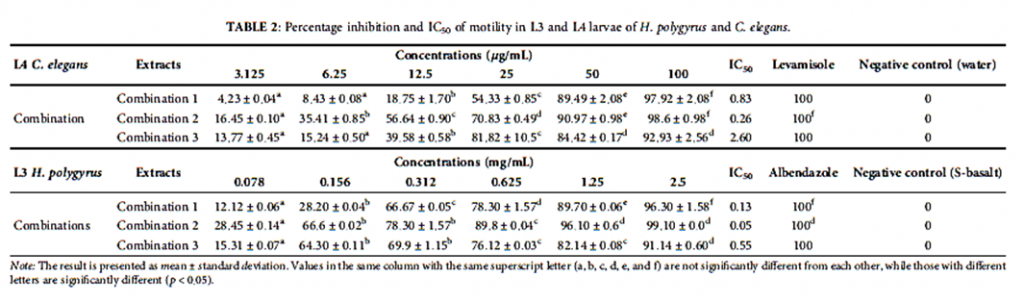
Anthelmintic Activity of Combined Extracts. Table 2 shows the IC 50s and PI of motility of L3 and L4 larvae of H. polygyrus L3 and C. elegans L4 larvae. Combination 2 with a proportion of 50%/50% is the most promising, with an IC 50 of 0.26 and 0.05 mg/mL, respectively, on H. polygyrus L3 and C. elegans L4 larvae. This was followed by Combination 3 with an IC 50 of 0.55 mg/mL for H. polygyrusL3 larvae. Combination 2 and Combination 3 with PIs of98 61 ± 0 98 and 99 14 ± 0 60, respectively, for H. polygyrusL3 and C. elegans L4 did not show a significant difference to albendazole and levamisole (100 ± 0 0).
This study provides scientific support for the traditional Chadian use of K. grandifoliola and F. albida stem barks against helminthiasis, showing that the 1:1 combination had the strongest anthelmintic effect, comparable to standard drugs, while also demonstrating antioxidant potential. These findings suggest that such plant combinations could serve as promising complementary treatments for soil transmitted helminth infections, especially in resource limited settings.
Journal of Parasitology Research, 2026.
Yamssi Cédric ,Noumedem Anangmo Christelle Nadia ,Baigomen Christalin, Mounvera Abdel Azizi ,Tako Djimefo Alex Kevin ,Vincent Khan Payne , and Haibo Hu.